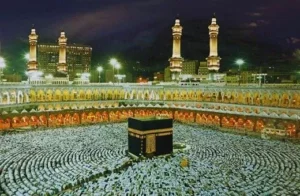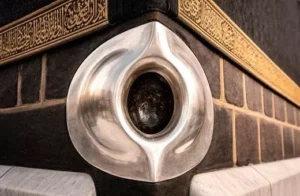
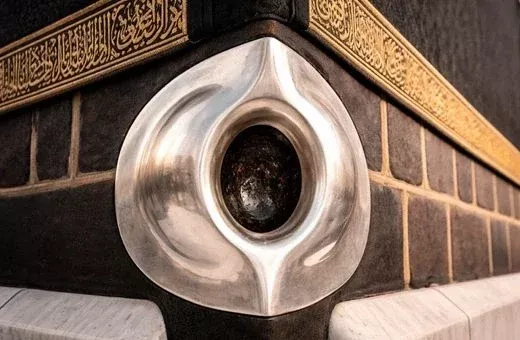
The Black Stone of the Kaaba — known as Hajre Aswad — is set into the eastern corner of the Kaaba inside Masjid al-Haram. It marks the starting and ending point of Tawaf and is honoured by Muslims as part of the Sunnah — not as an object of worship.
When people describe the Kaaba, they often speak about its scale: the vast courtyard, the flowing movement of Tawaf, the sea of pilgrims. Yet one of its most discussed features is surprisingly small.
That feature is Hajre Aswad.
Over centuries, this stone has been kissed, protected, debated over, removed, returned, repaired, and preserved. Through all of that, its meaning has remained unchanged: it is respected because the Prophet ﷺ honoured it — not because it holds power of its own.
Understanding this helps pilgrims approach it with clarity instead of confusion.
What Hajre Aswad Is — and What It Is Not
Hajre Aswad is fixed into the eastern corner of the Kaaba. Today, it appears as several dark fragments held together within a silver frame.
Islam is very clear on one point:
The stone itself has no divine power.
It does not forgive sins on its own.
It does not grant blessings independently.
It is not worshipped.
Its importance comes from prophetic practice and sacred history — nothing more.
This distinction protects Islamic belief from turning reverence into superstition.
The History of the Black Stone: From Prophet Ibrahim to Today
Islamic tradition tells us that when Allah commanded Prophet Ibrahim (AS) to rebuild the Kaaba, Angel Jibreel (AS) brought him the Black Stone to place in its corner. Some narrations describe the stone as originally white and later darkened over time.
Generations later, when the Quraysh rebuilt the Kaaba, a serious dispute broke out. Every clan wanted the honour of placing the stone.
Tension grew.
Then Prophet Muhammad ﷺ предложed a simple solution.
He placed the stone on a cloth and asked each tribe to hold one corner. Together, they lifted it. He then placed it in position himself.
A potential conflict ended through cooperation and wisdom.
That moment alone explains why Hajre Aswad represents unity as much as history.
Damage, Removal, and Preservation
The Black Stone has witnessed turbulent times.
It was damaged during attacks on Makkah. At one point it was removed entirely by the Qarmatians and kept away from the Kaaba for over twenty years.
When it was finally returned, it was fractured.
Muslim leaders carefully preserved the remaining pieces using protective silver casing. What pilgrims see today is not one smooth stone, but several fragments joined together.
Its condition quietly teaches a powerful lesson:
Faith endures, even when physically scarred.
The Spiritual Role of Hajre Aswad in Worship
The importance of Hajre Aswad lies in practice, not belief.
During Tawaf, pilgrims begin each circuit at the Black Stone. If possible, they may touch or kiss it. If not, they simply gesture toward it and continue walking.
Both are valid.
Hazrat Umar (RA) captured this balance perfectly when he said that he knew the stone could neither benefit nor harm — and that he honoured it only because he saw the Prophet ﷺ do so.
That single statement preserves Islamic belief from exaggeration.
Symbolism Without Superstition
Some narrations mention spiritual reward connected to Hajre Aswad. Others say it will testify on the Day of Judgment.
These meanings are understood within a wider Islamic framework:
Sincerity matters more than contact.
Intention matters more than proximity.
Repentance matters more than ritual motion.
No one is expected to push, argue, or hurt others to reach the stone.
If you cannot touch it, your Tawaf is still complete.
Experiencing Hajre Aswad During Umrah
For many pilgrims, their first encounter with Hajre Aswad happens during Umrah.
Crowds are dense. Emotions are high. Movement is slow.
This is where understanding becomes grounding.
Ihram is not only clothing — it is behaviour. Patience, restraint, and awareness of others are part of worship itself.
Many organised Umrah groups advise pilgrims to acknowledge the stone from a distance and focus instead on du‘a and reflection.
Clearing Common Misunderstandings
Let’s clarify a few points:
-
Touching Hajre Aswad is not mandatory
-
Missing it does not invalidate Tawaf
-
It carries no independent power
-
Islam values belief over objects
Once this is understood, Hajre Aswad becomes what it was always meant to be: a marker of tradition, not a miracle.
Why This Story Still Matters
Hajre Aswad connects generations:
It connects Prophet Ibrahim (AS) placing it into the Kaaba.
It connects the Prophet ﷺ resolving conflict with wisdom.
It connects pilgrims today walking the same path from every corner of the world.
It reminds Muslims that faith is built on obedience, humility, and remembrance — not spectacle.
A Final Reflection
For those preparing for Umrah, learning the meaning behind sacred elements like Hajre Aswad brings depth to the journey. It removes pressure and replaces urgency with calm.
You don’t need to fight crowds to feel close to Allah.
Sometimes, simply understanding is enough.
And when you walk past that small, ancient stone, you’ll know:
Your worship was never about touching it.
It was always about turning your heart toward Allah.