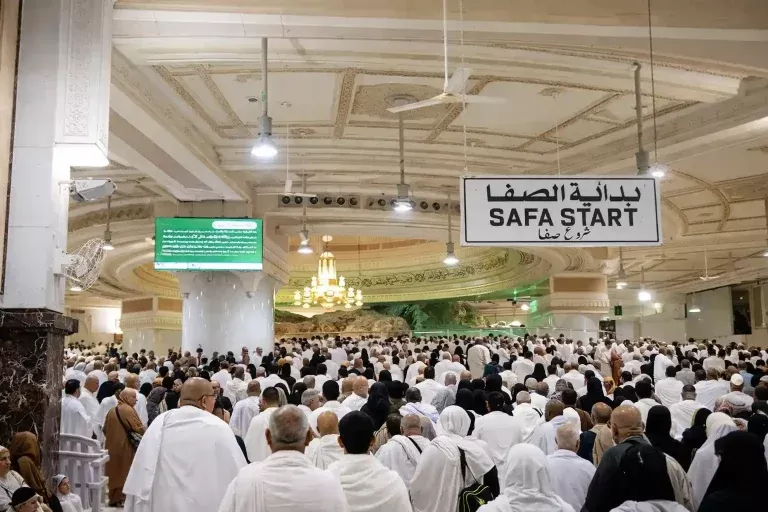
Safa and Marwa are two small hills located inside Masjid al-Haram in Makkah. During Umrah and Hajj, pilgrims walk between them seven times in a ritual known as Sa’i.
On the surface, it may look like simple walking.
But in reality, Sa’i is one of the most emotional and meaningful parts of Umrah — rooted in a powerful story of faith, struggle, and complete trust in Allah.
Many UK pilgrims later say the same thing:
“I wish I had understood the story before I performed Sa’i.”
Once you know the history, every step feels different.
Let’s walk through that story together.
Where Safa and Marwa Fit into Your Umrah Journey
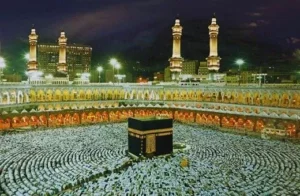
After completing Tawaf around the Ka‘bah, pilgrims move on to Sa’i.
You begin at Safa, walk to Marwa, then return — completing seven journeys in total. The full distance adds up to just over 3 kilometres.
Today, Safa and Marwa are connected by a bright, air-conditioned gallery inside the mosque. But what you’re really doing is reenacting an event that happened thousands of years ago.
Allah describes Safa and Marwa in the Qur’an as “among the symbols of Allah.” This makes Sa’i not optional, but an essential part of Umrah.
The Story Behind Safa and Marwa – Hajar’s Search for Water
To understand Sa’i, you need to go back to Prophet Ibrahim (AS), his wife Hajar, and their infant son Ismail.
By Allah’s command, Ibrahim (AS) left Hajar and Ismail in a barren desert valley near the Ka‘bah — with only a small amount of food and water.
Soon, their supplies ran out.
Baby Ismail began crying from thirst.
Hajar didn’t freeze. She didn’t give up. She moved.
She climbed Safa, searched the horizon, saw nothing — then walked across the valley to Marwa. Still nothing.
So she went back.
Again.
And again.
Seven times.
She ran in the low valley where she couldn’t see her son. She walked on higher ground where she could check on him. She searched desperately for help — but kept trusting Allah.
After her seventh journey, Allah answered.
Angel Jibril (AS) struck the ground near Ismail, and Zamzam water burst forth.
From desperation came mercy.
From effort came relief.
What Sa’i Symbolises for Every Muslim
Sa’i teaches us something deeply practical:
-
Trust Allah — but take action.
-
Make du‘a — but also move.
-
Hope even when everything looks empty.
Hajar didn’t sit still waiting for a miracle.
She worked while trusting Allah.
That’s why Sa’i exists today.
Every pilgrim walks her path.
Every pilgrim repeats her lesson.
Why Safa & Marwa Still Matter for Umrah Travellers Today
Modern Umrah travellers come with their own struggles:
-
Financial pressure
-
Family responsibilities
-
Health concerns
-
Work commitments
When you walk between Safa and Marwa, you’re silently saying:
“Ya Allah — I’m doing my part. I trust You with the rest.”
That’s the heart of Sa’i.
Effort plus tawakkul.
Fear plus hope.
Movement plus faith.
Practical Tips Before Performing Sa’i
Look After Your Body
-
Stay hydrated (drink Zamzam beforehand)
-
Wear comfortable footwear (within Ihram rules)
-
Take short rests if needed — there are accessible walkways for elderly and disabled pilgrims
Set Your Intention
Each round can carry its own du‘a:
-
For family
-
For health
-
For forgiveness
-
For your future
You don’t need long Arabic duas — speak to Allah from your heart.
Don’t Rush
A well-planned Umrah helps you arrive calmer and more focused. Exhaustion steals concentration from worship.
How Good Planning Makes Sa’i Easier
Your Umrah experience depends heavily on preparation.
Choosing the right flights, nearby hotels, and sensible timings means:
-
Less physical stress
-
Less rushing
-
More focus on worship
That’s why many UK pilgrims work with specialists like Minha Travel — not just for bookings, but for guidance that respects both logistics and spirituality.
Good planning gives you space to feel the moment.
Walking Between Safa and Marwa with Confidence
When you finally stand inside Masjid al-Haram and begin Sa’i, remember:
You’re following Hajar’s footsteps.
You’re reliving a story of desperation turning into mercy.
You’re proving — step by step — that you trust Allah even when answers aren’t immediate.
That’s why this ritual stays with people long after Umrah ends.
Ready to Plan Your Umrah Journey?
If you’d like help choosing dates, flights, or packages that suit your family and budget, Minha Travel is here to support you with practical guidance and personalised care — so you can focus on what truly matters.
Your journey starts with one step.
Just like Hajar’s did.